We are a technology and object obsessed generation. We may not all be rushing out to purchase the new Apple Watch or self-balancing-Segway-like electronic scooter, but most of us do at least own iPhone's and lap tops and have clothes from generic stores that source their products from sweatshops. On average we look at our phone screens every seven minutes yet we never question the ethical side of how our phone came to be. It is in our arsinal to use our devices to look up these facts but instead we chose use them to stalk the Kardashian family. We are never explicitly told the truth behind the ethics of Apple, or any other major brand that uses sweat shop labor to create their products, therefor we never bother to actively seek the truth ourselves.
We aren't told that "Because women make up 85 to 90% of sweatshop workers, some employers
force them to take birth control and routine pregnancy tests to avoid
supporting maternity leave or providing appropriate health benefits." or "In developing countries, an estimated 168 million children ages 5 to 14 are forced to work."
I will be looking the western worlds lack of remorse when it comes to unsustainable and unethical design and question whether the neglect of accountability for our consumerist actions is a form of sociological behavior. I also plan to focus on how we can use new age design to pull ourselves out of this environmental wasteland as we are the generation that is accountable for the actions of our ancestors past.
One source I have been looking at focuses on the history of industrial pollution and how we begun to think it was okay to pollute the earth the way we do currently. The article states that "Earlier, industries were small factories that produced smoke as the main
pollutant. However, since the number of factories were limited and
worked only a certain number of hours a day, the levels of pollution did
not grow significantly." (Kukreja) Now with our modern motto being "more is more" factories have both multiplied and upscaled significantly whilst continuing to dump their waste in the same manner as when they were smaller. Thus, greatly polluting our planet.
Kukreja, R. Industrial Pollution. conserve-energy-future.com.
Link:
http://www.conserve-energy-future.com/causes-effects-of-industrial-pollution.php
(This website had very little information about the dates and time of the article releases.)
Tuesday, 18 August 2015

Monday, 10 August 2015
Critical Selfie: The Art of Abandon
THE ART OF ABANDON
As
I flâneured my way through Wellington I couldn't’t help but be enticed into the
various alleyways and crevices of the city’s design. These alleyway’s led to no
where and their usability was obsolete yet their rustic appearance was simply
captivating. Many would deem these
abandoned spaces collateral damage of the human existence. Other would call
these spaces canvas’. I argue that these
“others”, other wise knows as street artists, are creating explicitly for flâneurs
as they share a passion for contributing parts of their being to the urban
environment for the flâneur’s to discover and create a “narrative” (Lucas,
171) for.
A
lot of people have a problem with street art as they want to hold on to the
imagery of the past. Yet they don’t understand how fast we forget the old
layout of their city and become accustomed to the new form. Many people use the
title vandalism for street art, yet these artists are just redefining a space
which was once completely abandoned.
My
editing choices were just as important as my photography choices. The original
colour distortion was to add emphasis on how street art adds vibrancy to the
otherwise dull colours of these buildings.
Towards the end the colour distortion was to show that as the earth
keeps spinning the streets will forever continue to change and develop.
Lucas,
R (2008) ‘Taking A Line For A Walk”: Walking As An Aesthetic Practice. Ways Of
Walking: Ethnography And Practice On Foot. Hampshire: Ashgate.
Wednesday, 5 August 2015
Interim 2: The Art of Abandon
In the last interim I had the ridiculous idea to photograph wellington
from the view of a homeless person. Since then I have realized how
terrible that idea actually is and I have decided to revive my original
idea of exploring the street art in the seemingly abandoned areas of
Wellington. I would like to explore how baron our streets would be
without these artists coming in and livening up our city, as if you
really look at the Cuba street area it's buildings are extremely old,
unkempt and rather industrial. I think that the art livens up these
baron walls and transforms the forgotten parts of our city into urban
galleries. Alongside the art in many of these alleyways and on these buildings is ivy or moss growing. This literally is bringing life back to these baron areas that the humans of Wellington have passed off as wastelands.
I'm interested in playing with the contrast and colour levels of these images to make the street out pop against the brick buildings they are painted on. I want to highlight the contrast between the state of the abandon the building is in and the level of care the artist has both for their field of work and their passion for making a beautiful area out of a place that everyone else has neglected
I'm thinking of using the intro to a taylor swift remix for my ambient music. It sounds very cliche and horrible but the remix gives a level of deep eeriness to the song.
https://www.youtube.com/watch?v=82Eu4HRjua4
I only plan on using the first 40 seconds of the song, before the lyrics come in.


Monday, 27 July 2015
Interim: Behind The Sign
BEHIND THE SIGNMy
camera and I have been going on walks through the city in order to get
inspired
and more connected to this project and Wellington itself but the more I
observe
my surroundings, the more I realize how limited my perception on being a
creature of Wellington is. I am a relatively white, relatively middle
class and
relatively young female. I have never been discriminated on for my race,
never
gone to bed hungry and never slept outside without the option to move to
my bed
when the temperature of the night falls. My perspective of urban living
is a privileged one, and one that I don’t feel deserves a critical photo
essay on.
As I walk around wellington I notice people who are less fortunate than myself. I notice people who’s opportunities in life are far more limited than mine. I would like to eliminate my perspective from this project and photograph the viewpoint from behind the signs of the homeless culture in Wellington.
For this project I would like to capture what it is like to live on the street and watch thousands of people walk past your home everyday. The images wont be of the homeless themselves, but of what they see, as that is a viewpoint many of us have never experienced. I aim to use a wide or fish eye lens to encapsulate as much of my subjects surroundings as possible.
--------------------------------------------------------------------------------------------------------------------------
My concerns are that my idea is will only further isolate this community from what we would classify the common society as it could come off that I am only using this perspective to achieve something for myself. In no way am I looking to belittle someones position in life, I simple want to show the viewpoint of how differently wellington's urban environment can be experienced.
Here are some images I have been taking on my walks. Before I was inspired to change my perspective I was actively looking for parts of Wellington that were abandoned, unkempt and grungy. I was looking for a variety of different textures, both natural and unnatural. It was interesting how easy it was to find what I was looking for.


Thursday, 30 May 2013
Step up your writing
In assignment four I made the statement
that the pair of Bauhaus Wassily chairs I found on
Trade Me were timeless. I stated that although these chairs were first
pioneered in the 1920’s they still have a sheik and fresh contemporary look and
would be favorably welcomed when furnishing a household in 2013. I argue that the
Bauhaus art form is still a prominent influence in contemporary design both in
physicality and rationalist intention.
Physically the Bauhaus art form is prominent in our current style as it is very industrial and involves a lot of metal and leather and is made to look simplistic. A recent rendition of the Wassily Chair, that I chose to search on Trade Me in project four, is this Zetel Chair; Designed by minimalists Fein Muller and Hannes Van Severen. Much like the Wassily Chair, this chair has a refined metal pipe-like structure and a thick leather material as the component that is sat on. These designers have used the basic outlines of the Bauhaus styled Wassily Chair but have heavily simplified the craft and expanded the design to make it seat two.
Physically the Bauhaus art form is prominent in our current style as it is very industrial and involves a lot of metal and leather and is made to look simplistic. A recent rendition of the Wassily Chair, that I chose to search on Trade Me in project four, is this Zetel Chair; Designed by minimalists Fein Muller and Hannes Van Severen. Much like the Wassily Chair, this chair has a refined metal pipe-like structure and a thick leather material as the component that is sat on. These designers have used the basic outlines of the Bauhaus styled Wassily Chair but have heavily simplified the craft and expanded the design to make it seat two.
 |
We don’t notice the Bauhaus influence in our everyday furniture but it is influential in many of the top designs of today and their values are important in our global endeavor to create sustainable and rational designs. The Bauhaus movement started after the Second World War, when Germany was low on resources and focused on creating rational products and designing for the mass production. This is how their slogan “Art into Industry.” (Gropius) came about. This relates to our contemporary issue of global warming and the new pressure to make eco-friendly and affordable furniture in mass amounts for and international buyers. Instead of lack of resources due to war, we as a planet are beginning to run out of natural resources and are striving to invent new environmental materials to work with.
Griffith Winton, Alexandra. "The Bauhaus, 1919–1933". In Heilbrunn Timeline of Art History. New York: The Metropolitan Museum of Art, 2000–. http://www.metmuseum.org/toah/hd/bauh/hd_bauh.htm (August 2007)
Muller, Fien & Van Severen, Hannes. Duo Seat. Muller Van Severen. Retrieved May 29, 2013, from http://mullervanseveren.be/site/duo-seat-lamp/.
Tuesday, 14 May 2013
Trade me hunt
-->
-->
-->
Today on Trade Me I tried to look for a one person Bauhaus styled chair that would be both appropriate for someone on a student budget to purchase and an appropriate size for a student’s room.
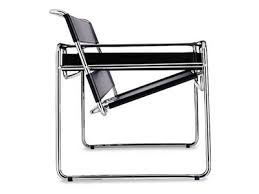
In searching for the chair simply typed Bauhaus into the general search engine on trade me. I chose to define the search for this object by clicking on the home and living section of trade me so I wouldn’t have to sift through all of the random items linked to this word. Here three items popped up, one of which was appropriate to my specifications listed before, one that was appropriate but pricier and more aesthetically pleasing, and one, which was irrelevant to the provisions. The chair I chose to focus on was a Wassily chair and the second most expensive but best looking. The chair is not an original but a respectable replica of the original styled chair that minus a few spots of rusting looks to be in good condition.
The guy listing it has done a great job at describing the chair as he gives a manageable but informative history of the chairs creator, Marcel Breuer, the inspirations behind the chair, it’s dimensions, materials and it’s status in society today.
“Marcel Breuer was an apprentice at the Bauhaus in 1925 when he came up with the design idea for this chair. The frame was inspired by the tubular frame of a bicycle. This chair was revolutionary in the use of the materials (bent tubular steel and canvas) and methods of manufacturing. It is now considered one of the most iconic chairs of the 20th Century.”
The chair has sleek metal and leather materials, which are proving to be timeless as even though it was first designed in the late 20’s, it’s still relevant and sheik in present contemporary design styles. This chair emulates the beliefs of how Walter Gropius, thought designs should be as it uses industrial components of engineering and manufacturing with the tubular like structure. I chose a second hand replica, as it looks to be well made and in good condition whilst being a lot cheaper than an original Wassily chair or brand new Replica of this product.

Jen422. Pair of Wassily Chairs. Trade Me.
http://www.trademe.co.nz/Browse/Listing.aspx?id=592774245
The guy listing it has done a great job at describing the chair as he gives a manageable but informative history of the chairs creator, Marcel Breuer, the inspirations behind the chair, it’s dimensions, materials and it’s status in society today.
“Marcel Breuer was an apprentice at the Bauhaus in 1925 when he came up with the design idea for this chair. The frame was inspired by the tubular frame of a bicycle. This chair was revolutionary in the use of the materials (bent tubular steel and canvas) and methods of manufacturing. It is now considered one of the most iconic chairs of the 20th Century.”
The chair has sleek metal and leather materials, which are proving to be timeless as even though it was first designed in the late 20’s, it’s still relevant and sheik in present contemporary design styles. This chair emulates the beliefs of how Walter Gropius, thought designs should be as it uses industrial components of engineering and manufacturing with the tubular like structure. I chose a second hand replica, as it looks to be well made and in good condition whilst being a lot cheaper than an original Wassily chair or brand new Replica of this product.
Jen422. Pair of Wassily Chairs. Trade Me.
http://www.trademe.co.nz/Browse/Listing.aspx?id=592774245
Wednesday, 1 May 2013
Poster

Keely
Meechan’s work integrates the Rococo like curvature and spontaneity with the
sleek and clean components of Modern design, resulting in a pleasant
juxtaposition of natural and unnatural features. The designs are molded in a
way that presents a flow of plastic being disturbed by the sternness of the
solid metal, like an abandoned plastic bag flowing in the wind whilst trapped
in the branches of a tree.
This exhibition is heavily influenced by the natural elements of nature and the human’s invasion that is slowly destroying it. Humans create more waste than our world can handle and take little notice of the effect this is having on our eco system and quality of life.
Through this exhibition I strive to enlighten you on the impact product waste has on our planet and influence you to be innovative about our planets future. I strive to raise questions among the audience about our relationship with our waste. Could rubbish be used as a medium for creative outlet? Could we use the plastic recycling as a material for new recycled sculptures? Could the way we mindlessly discard our rubbish change if we were to use it as an artistic symbol?
Visit the Wellington City Art Gallery to experience the excitement and ingenuity of Meechan’s latest work.
Subscribe to:
Posts (Atom)